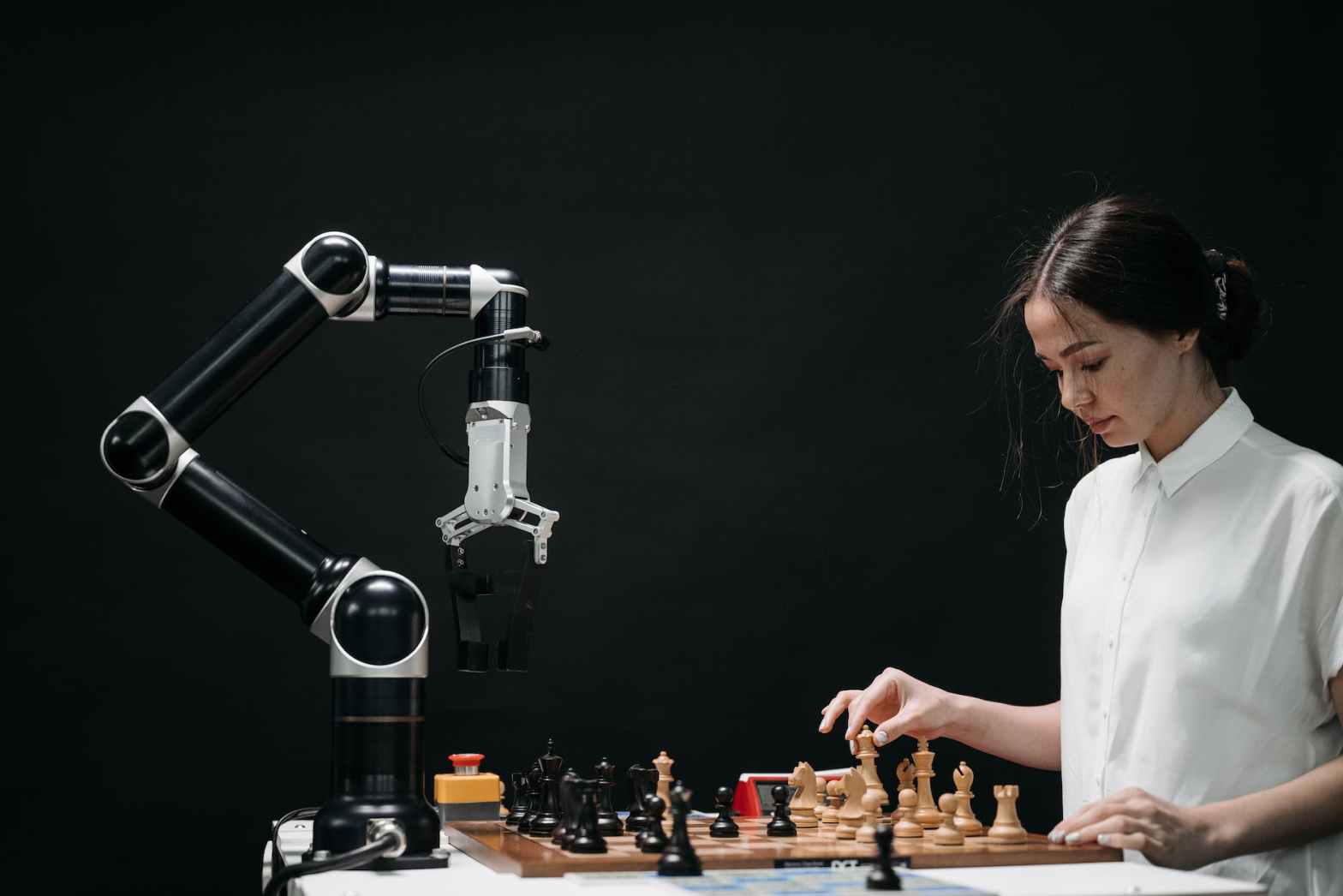
In today’s increasingly digital world, the intersection of STEAM (Science, Technology, Engineering, Art, and Mathematics) and Artificial Intelligence (AI) in our classrooms is a pressing necessity and reality. AI models with research-based instructional strategies can significantly enhance and enrich our teaching practices, preparing our K-20 learners for a technology-infused future.
One transformative methodology that AI applications like ChatGPT, Bard, Claude and the 100’s of other AI tools available to teachers and students can support is Design Thinking. This iterative, non-linear process can guide our students in constructing creative and practical solutions to complex problems. The process employs the following steps:
- Empathize: Understand the needs and challenges of the user.
- Define: Reframe and define the problem in user-centric ways.
- Ideate: Encourage expansive thinking to generate multiple possible solutions.
- Prototype: Build a representation of one or more solutions.
- Test: Try out the solution and seek feedback for refinement.
Consider a project that encourages students to incorporate engineering principles, mathematical logic, and artistic design to build a technology solution. In this process, students could leverage AI tools can explore ideas, simulate experiments, and obtain feedback on their designs. Whether it’s a first-grader building a simple machine or a college student programming a complex algorithm, these steps can be adapted to any educational level, subject, or challenge. Ultimately, teachers will need to ensure students have prior knowledge related to the concepts and skills being taught, including teaching students through a scaffolding sequence of how to prompt the AI tool to support them in completing a task.
Moreover, AI can also play a significant role in the research and experimental prediction process. The wealth of information accessible through AI can assist students in data analysis, result interpretation, and solution refinement. For example, students can copy and paste to ChatGPT or upload data to ChatGPT Plus Data Analysis tool, which can allow for statistical analysis and data visualization.
Our latest book, “Amplify Learning: A Global Collaborative – Amplifying Student Inquiry in, Robotics, Computer Science, and STEAM,” delves deeper into these aspects to support teachers integrating these concepts and skills into all elements of our traditional curriculum. Through its chapters, we showcase the integration of computer science principles, robotics, and STEAM, emphasizing real-world problem-solving and hands-on experience. The essence of our book is to instigate a shift in mindset and provoke serious thinking, making learning real, tangible, and relevant for our K-20 learners.

Join us on this exciting journey as we shift paradigms and pave the way for an AI-driven future in education. As we champion, “To teach STEAM is a shift in mindset.”
Learn more about the book and our AmpGlobalEdu book series at www.ampglobaledu.com. Additionally, follow the hashtag #AmpGlobalEdu on social media to see updates related to the book and book series from our editors and contributing authors.
 Navigating the Present and Future of Education