
Yesterday, my friend and colleague, Dr. Drew Hinds, shared a newish framework (2023) for evaluating educational technology and integrating technology in schools with me, and it has been percolating around in my head ever since. It’s called the VATT (Value Add of Technology on Teaching) framework, and in a landscape crowded with models and frameworks like TPACK and SAMR, I was initially intrigued, but also skeptical about how it was developed from the research body. However, the more I explore it, the more I believe VATT offers something fundamentally different and, for school leaders, perhaps something fundamentally more useful than previous EdTech frameworks that primarily only focus on instruction at the teacher level.
(Leading Educators, 2023)
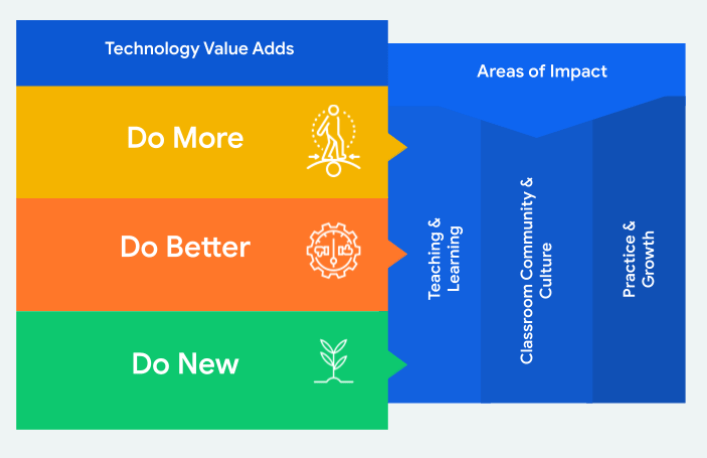
After reviewing some of the literature, I believe the VATT framework’s true strength is its attempt to provide three different dimensions and layers to how technology adds—or fails to add—value. Unlike many major technology integration frameworks that focus almost exclusively on classroom instruction (I’m looking at the TPACK, SAMR, and even the Danielson Framework), VATT takes a wider, more systemic view. It evaluates EdTech’s impact across three distinct domains:
- Teaching & Learning: The direct impact on instructional activities and student outcomes.
- Community & Culture: How technology affects relationships, communication, and belonging among students, families, and staff.
- Practice & Growth: The role technology plays in the professional development and operational effectiveness of educators.
Because of this multi-layered approach, I believe the VATT is less of an instructional coaching tool and more of a systems-based EdTech integration tool. It’s built for school and district leaders to collaborate with teachers, students, and the community. It provides a shared language to help them collectively decide whether adding a new tool—or perhaps more importantly, subtracting an existing one—would positively or negatively impact the whole educational ecosystem.
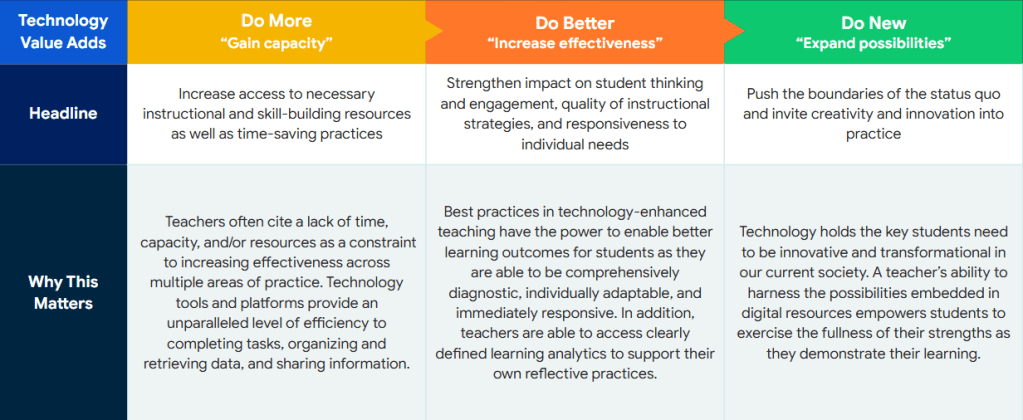
The framework further breaks down the type of value into three interesting categories: Do More, Do Better, and Do New. This is where my analysis gets a bit more nuanced.
(Leading Educators, 2023)
I really like the “Do More” and “Do New” categories. “Do More” rightfully acknowledges that sometimes, the biggest value-add is efficiency, giving teachers back their time by streamlining workflows so they can focus on the human side of teaching. “Do New” captures the exciting potential of technology to unlock novel forms of creation and expression, allowing students to demonstrate their knowledge in a multitude of powerful ways.
My main critique lies with the “Do Better” category. While it touches on key themes like using learner analytics to personalize instruction, I wish it had cognitive science and the principles of learning as its explicit foundation. It stops short of detailing what truly sound instruction with technology looks like. It discusses the “what” (personalization) but not enough of the “how” (the specific, evidence-based instructional strategies). This, however, might be by design. Perhaps this is the precise point where VATT is meant to be supplemented by a more instructionally-focused framework. School, district, and even teacher leaders can use VATT for the 30,000-foot systems check, and then plug in a model like TPACK to drill down into the pedagogical details of the “Do Better” category with their teachers.
With all of this said, the VATT framework seems like a sound and much-needed addition to reviewing and implementing EdTech within schools and districts when thinking and doing it at an organizational level. Since it’s relatively new, its potential is still largely theoretical. Now, the real test begins. I’m eager to see case studies from districts and schools that adopt it. What are their results over time regarding student learning, as well as technology usage and budgetary impacts? Does this systemic lens change how they procure and manage technology? Does it, as I suspect it might, help them thoughtfully curate their digital ecosystem and reduce the number of redundant or ineffective tools?
My final thoughts: The VATT offers a promising, holistic way to approach EdTech decision-making at a school, district, and even departmental level. I, for one, will be looking forward to seeing more of it in the future when case studies and more research are available on its implementation. You can learn more about the VATT at valuedtech.org/framework.
 Navigating the Present and Future of Education