“That’s one small step for man, one giant leap for mankind.” — Neil Armstrong (1969)
The Mission Control Mindset
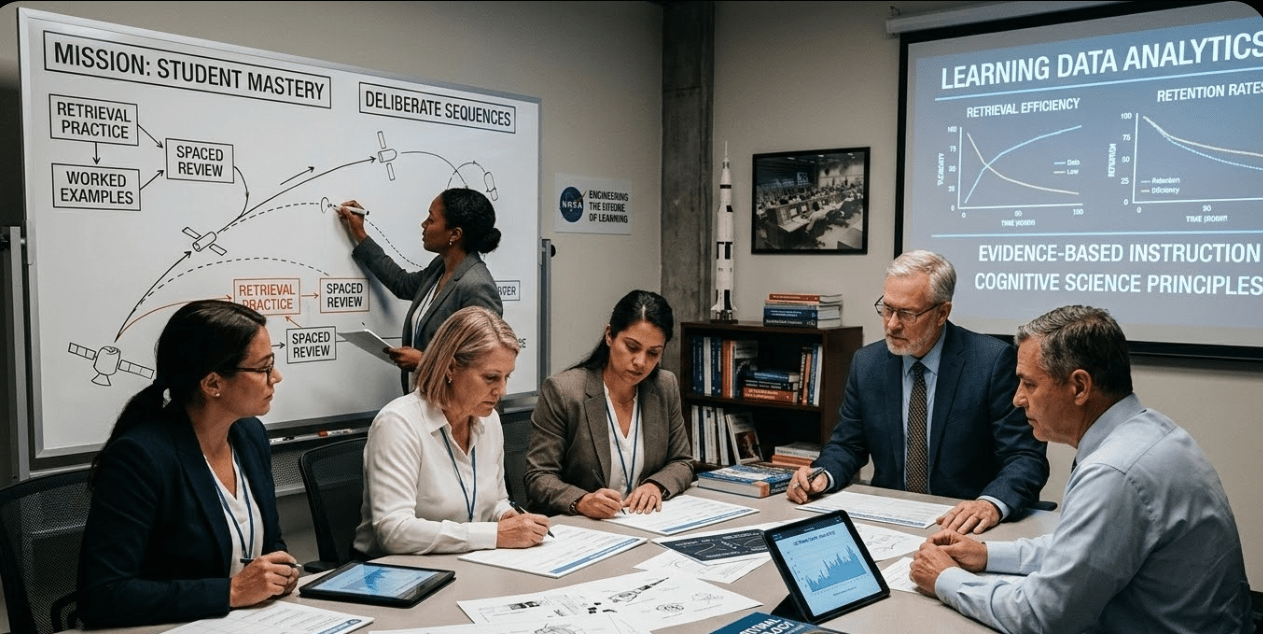
Picture a professional development session where teachers design instruction the way NASA engineers design a mission. The stakes are high. The sequences are deliberate. Every decision is backed by data, rehearsed under pressure, and built for the moments when precision matters most. The same discipline that gets astronauts to the moon applies directly to how students build lasting knowledge in our classrooms. Cognitive science has given us a clear picture of how learning works: retrieval practice, spaced review, worked examples, and explicit instruction consistently outperform passive approaches. The evidence isn’t new. What’s new is the urgency to act on it.
Just as NASA engineers don’t leave a mission’s success to chance, we can’t afford to leave learning to chance either. Let’s look at how the precision of space exploration maps onto an instructional launch sequence built on cognitive science.
Principle 1: Retrieval Practice as Launch Rehearsal
Before any launch, astronauts run through countless rehearsals: not because the crew is uncertain, but because the stakes demand it. Repetition under realistic conditions is what separates readiness from assumption. Retrieval practice in the classroom operates on exactly the same logic. Research consistently demonstrates that pulling information from memory strengthens it far more than re-reading or passive review (Roediger & Karpicke, 2006). Every time a student retrieves a piece of knowledge, even imperfectly, they are reinforcing the neural pathways that make that knowledge usable later. This is not a quiz strategy. It is a memory strategy.
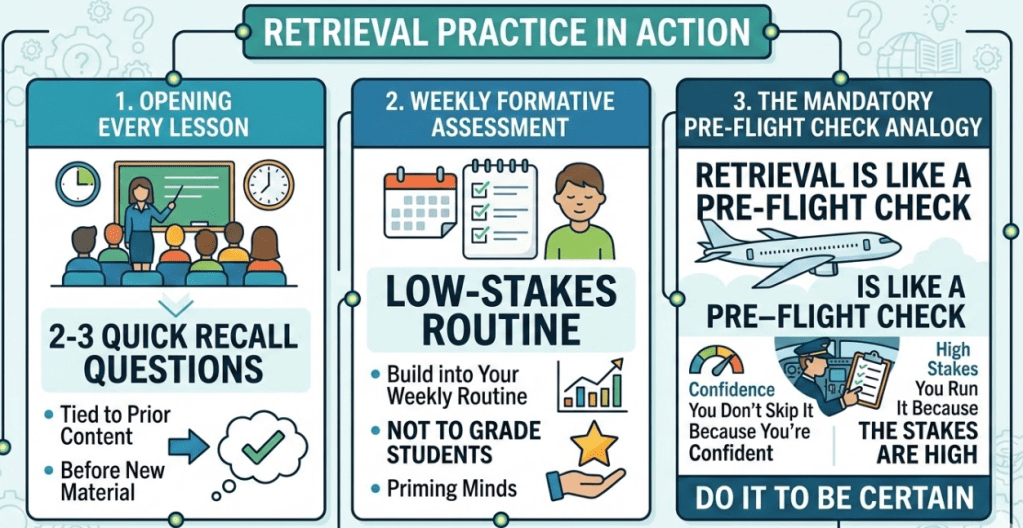
In practice, this means opening every lesson with two or three quick recall questions tied to prior content before introducing anything new. It means building low-stakes formative assessments into your weekly routine: not to grade students, but to prime their minds. Think of retrieval like a mandatory pre-flight check: you don’t skip it because you’re confident everything is fine. You run it precisely because the stakes are high enough to be certain.
Principle 2: Spacing and Interleaving as Mission Timeline Thinking
A mission to Mars isn’t planned in a single day. Engineers work backward from a launch window across months of sequenced preparation, deliberately building in checkpoints, simulations, and redundancies. Robust learning works the same way and most instructional schedules ignore this completely.
The spacing effect is one of the most replicated findings in cognitive psychology. Students who encounter the same material across multiple distributed sessions retain significantly more than students who receive the same total instruction in a single blocked session (Cepeda et al., 2006). The forgetting that happens between sessions isn’t a problem to eliminate. It’s the mechanism that makes spaced review so powerful. Retrieval difficulty is productive difficulty.
Interleaving compounds the benefit. When we mix problem types across practice sessions instead of grouping them by concept, students develop stronger pattern recognition and transfer skills. They learn to ask, “What kind of problem is this?” before defaulting to a procedure — which is exactly the thinking we want them to carry beyond the classroom. The practical implication is straightforward: take a concept from last month and weave it into this week’s practice. Don’t teach a concept once and never return to it. Build a mission timeline, not a checklist.
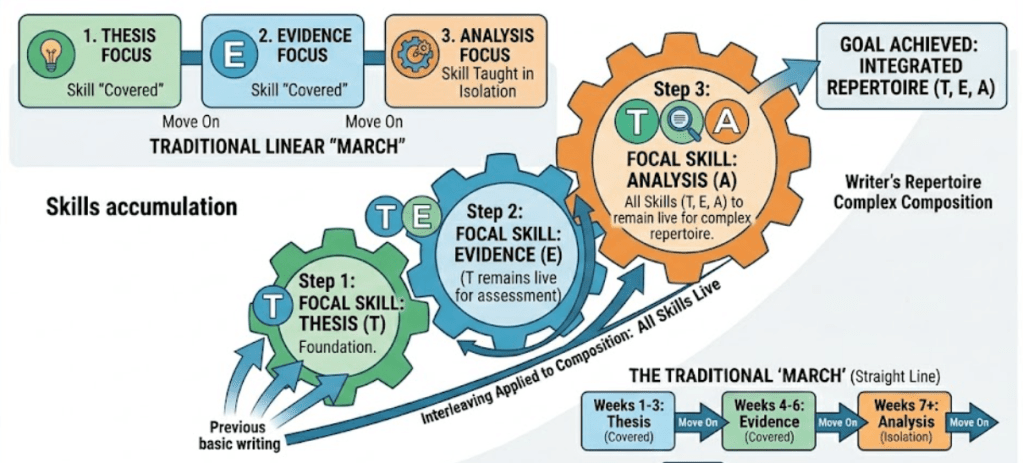
I saw this play out directly this week while coaching a preservice ELA teacher on her writing instruction sequence. She had been spending several weeks building students’ ability to write strong thesis statements focused, deliberate work on a single skill. The temptation at that point is to declare the skill “covered” and move on. Instead, we mapped out a different approach. She introduced finding and integrating textual evidence as the next focal skill, but rather than setting thesis statements aside, she kept assessing them. Students were now writing thesis statements and selecting evidence, with both skills live in every writing task. As weeks progressed and evidence integration became more fluent, we planned to layer in a third skill, analysis and commentary, while continuing to assess the earlier two. The result is a writing curriculum that spirals forward rather than marches in a straight line. Students aren’t just learning skills in isolation; they are building a writer’s repertoire where each new competency is practiced alongside everything that came before it. That is interleaving applied to composition and it is exactly what the research predicts will produce deeper, more transferable writing skill over time.
Principle 3: Worked Examples as Precision Procedures
Astronauts don’t guess how to fix a module. They follow precise, modeled procedures that have been tested, documented, and rehearsed before any real-world application. The classroom equivalent is the worked example and cognitive load theory tells us exactly why it works.
When students watch an expert solve a problem completely before attempting it themselves, they are able to focus their limited working memory on understanding the structure of the solution rather than juggling the mechanics of solving it (Sweller, 1988). This is especially true for novice learners who haven’t yet built the schemas that let experts chunk complex information effortlessly.
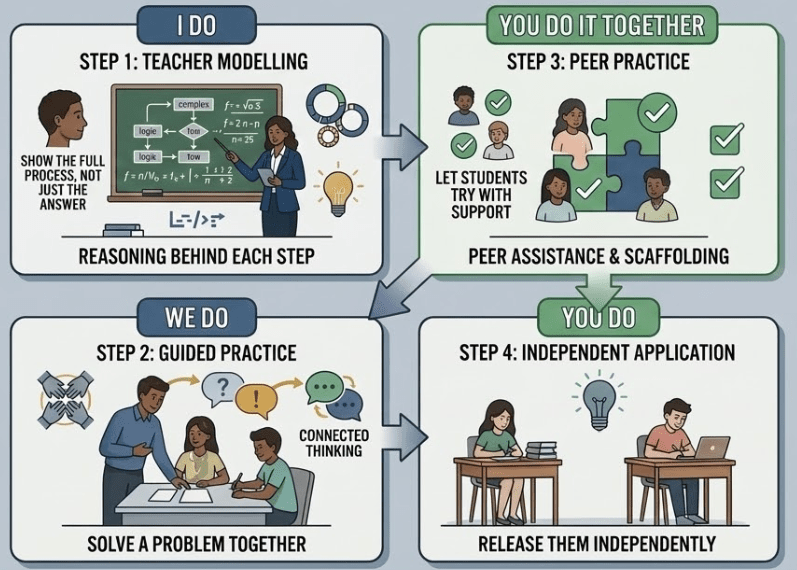
The key is gradual release. Show the process fully first, not just the answer, but the reasoning behind each step. Then solve a problem together. Then let students try with support. Then release them independently. This sequence isn’t just good pedagogy; it matches exactly what cognitive science predicts will happen in working memory under conditions of high novelty. One important caveat deserves attention here: the expertise reversal effect. As students gain proficiency, fully worked examples can actually increase cognitive load by forcing them to reconcile the worked solution with their own emerging understanding (Kalyuga et al., 2003). Advanced learners benefit from reduced scaffolding, not more of it. Knowing your learners means knowing when to take the training wheels off.
NASA Visuals as Cognitive Anchors
Authentic imagery isn’t decoration: it’s a powerful mechanism for grounding abstract content in something real. Mayer’s (2009) multimedia learning principles make clear that well-chosen visuals reduce cognitive load and improve retention when they are directly paired with the concepts being taught. Real NASA imagery gives us some of the most compelling instructional visuals available anywhere.
Consider what becomes possible when we think about NASA content as a pedagogical tool rather than a motivational poster. The barren, rocky terrain of Mars becomes a concrete entry point for discussing geological processes, erosion, and Earth biome comparisons in a way that a textbook diagram rarely achieves. High-resolution infrared imagery from the James Webb Space Telescope makes abstract concepts like light, wavelength, and cosmic time suddenly tangible. A slow-motion launch sequence carries more instructive weight for a physics lesson on thrust and aerodynamics than any textbook diagram of a rocket. The goal is to make the abstract concrete and few things are more concrete than a photograph taken 100 million miles from Earth.
Your Mission This Week
None of this requires a curriculum overhaul or a new initiative. The research supports small, deliberate moves compounded over time which is, appropriately enough, exactly how missions are built. Here are four specific actions you can take before the end of the week.
Open your next lesson with three quick recall questions drawn from content students encountered at least a week ago. Take one concept from last month’s instruction and weave it deliberately into this week’s practice: no announcement needed, just integration. Fully solve one example problem on the board before asking students to try it independently, narrating your reasoning aloud as you go. And find one authentic NASA image that connects to something you’re currently teaching, share it with students, and ask for a written scientific reflection.
Four moves. Each one grounded in the research. Each one executable today.
The Launch Question
What would change in our classrooms if we treated every lesson like a mission launch with the same precision, intentionality, and commitment to evidence? The cognitive science gives us a clear answer: outcomes would improve. Student retention would deepen. Transfer would increase. The question has never been whether the research works. The question is whether we are willing to build instructional systems worthy of it.
The runway is clear. The science is solid. Initiate the launch sequence.
References
Cepeda, N. J., Pashler, H., Vul, E., Wixted, J. T., & Rohrer, D. (2006). Distributed practice in verbal recall tasks: A review and quantitative synthesis. Psychological Bulletin, 132(3), 354–380.
Kalyuga, S., Ayres, P., Chandler, P., & Sweller, J. (2003). The expertise reversal effect. Educational Psychologist, 38(1), 23–31.
Mayer, R. E. (2009). Multimedia learning (2nd ed.). Cambridge University Press.
Roediger, H. L., & Karpicke, J. D. (2006). Test-enhanced learning: Taking memory tests improves long-term retention. Psychological Science, 17(3), 249–255.
Sweller, J. (1988). Cognitive load during problem solving: Effects on learning. Cognitive Science, 12(2), 257–285.
 Navigating the Present and Future of Education