
The Gradual Release of Responsibility (“I do, We do, You do”) is a powerful framework for instructional coaching, and it can be delivered directly through co-teaching strategies. Instead of a coach modeling and then simply observing, the crucial “We do” phase becomes a hands-on, collaborative partnership. This post explores how to use specific co-teaching models as the bridge from “I do” to “You do.” I share a single-session example of supporting a teacher with multilingual learners, moving from my “I do” (model) to our “We do” (“Team Teaching”) and finally to their “You do” (with me in a “One Teach, One Support” role), all within a single lesson.
Tag Archives: coaching
From Digital Consumers to Digital Pedagogues: A Framework for Moving Teachers from Digital Consumers to Tech-Enabled Pedagogues

In my work with teachers, I’ve seen firsthand a significant challenge that has only accelerated in our tech-saturated world: the gap between how pre-service teachers use technology and their capacity to teach with it. This is the Consumer-to-Pedagogue Gap, and it is one of the most critical hurdles we must overcome in modern teacher preparation and on-going professional development and coaching as they progress forward in their careers.
This post outlines a framework to bridge this gap, moving teacher candidates from passive digital consumers to active, tech-enabled pedagogues. The central thesis is straightforward: we must replace passive observation with a system of structured, low-stakes rehearsal. This over time will improve instruction as well as the use of technology when integrated together.
This system is not built on intuition; it is grounded in established learning science, specifically the Technological Pedagogical Content Knowledge (TPACK) framework and Cognitive Load Theory (CLT). These are the foundational lenses I advocate for in all effective instructional design.
EdTech Leadership in the Age of AI: What Matters Most When Everything is Changing

My coffee is still warm when the first alert comes in. A teacher cannot access Canvas, and their students are stuck at the login screen. I walk the teacher through the SSO steps, confirm access, and move on. By midmorning, I have visited classrooms, supported teachers with technology integration, and observed lessons to plan follow-up coaching. After that, I sit with our engineers to review system performance, troubleshoot issues, and test several EdTech tools and updates planned for release.
At two o’clock, there are three messages on LinkedIn about a new AI tool that promises to transform learning. I scan one, note the potential and the hype, and return to the work I already committed to do. The afternoon goes to email, planning professional learning, and reviewing the week ahead.
Sound familiar?
For many of us in EdTech and instructional leadership, this mix of strategic and immediate work is the norm. Some hours go to multi-year plans, budgets, and compliance. Others are dedicated to making sure one specific app works for one teacher so students can keep learning. The pace makes it easy to lose focus when the day is packed and many things are going on simultaneously. I return to a single question: how do people learn, and how can instruction and technology work together to support that? If we cannot answer that question, systems, budgets, and tools will have little impact.
This post shares how I connect what we know about learning with the daily realities of leading technology and instructional change in schools. I will describe several major themes and then provide a summary of the next steps to help you further reflect upon your leadership and programs.
Instructional Coaches Need to Know How Memory Works – And It’s Not a Muscle

I often hear memory described as a muscle—something that gets stronger the more you “work it out.” While the sentiment is well-intentioned, it’s a misleading metaphor. Our memory isn’t a single entity that we can simply beef up through brute force. It’s a complex system, and for instructional coaches, understanding its nuances is a game-changer for helping teachers truly embed new and refined strategies into their practice as well as teach the teachers we are coaching how learning happens.
Scaling Instructional Coaching: Overcoming Key Challenges

While the evidence for instructional coaching’s effectiveness is compelling, translating this potential into widespread impact presents significant challenges, particularly when attempting to scale programs across schools or districts. A primary concern, identified by Kraft et al. (2018), is the potential dilution of quality as coaching programs expand. The personalization and strong relationships that underpin effectiveContinueContinue reading “Scaling Instructional Coaching: Overcoming Key Challenges”
Aspire to Lead Podcast Appearance: Revolutionizing Collaboration in Schools Through Inclusion

About a month ago, I had the pleasure of joining the Aspire to Lead podcast to discuss co-teaching and instructional coaching. Episode Description: In this episode of Aspire to Lead, Dr. Matthew Rhoads, author of Co-Teaching Evolved and Crush It from the Start: 25 Tips for Instructional Coaches and Leaders, joins me to explore how artificial intelligence is reshapingContinueContinue reading “Aspire to Lead Podcast Appearance: Revolutionizing Collaboration in Schools Through Inclusion”
Digital Learning Today Podcast Appearance: Episode 66 – Crush it From the Start – Top Tips for Instructional Coaches
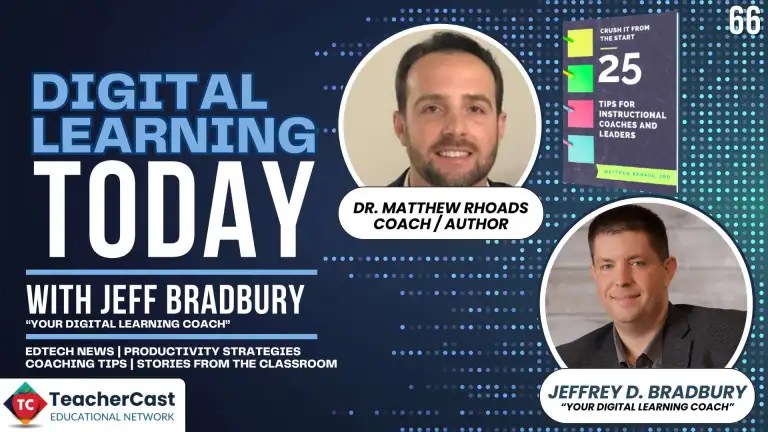
This podcast episode emphasizes the significance of understanding cognitive science, effective coaching strategies, and the integration of technology in education. The conversation also touches on the challenges faced by coaches and the need for reflection and balance in their professional lives.
New Release! Crush it from the Start: 25 Tips for Instructional Coaches and Leaders

Today marks the release of my new book—a resource designed for instructional coaches, principals, assistant principals, college of education professors, and district office leaders who are committed to transforming teaching and learning in the modern classroom. This book isn’t just about coaching strategies; it’s about understanding the content necessary to navigate education in the ageContinueContinue reading “New Release! Crush it from the Start: 25 Tips for Instructional Coaches and Leaders”
The Power of Rehearsal: The Most Overlooked Step in Instructional Coaching

Instructional coaching is a powerful tool for transforming teaching and learning, but one of its most underutilized strategies within instructional coaching is lesson rehearsal by the teaching being coached—a safe, structured opportunity for teachers to practice new instructional strategies before implementing them in the classroom. Check out how this critical element of instructional coaching can be implemented and be apart of your coaching toolkit and practice.
Proving Our Impact: How Instructional Coaches Can Use Regression Analysis to Demonstrate Their Value

Recently, my PLN colleague Roxi Thompson posed some compelling questions on LinkedIn: How do you collect data to demonstrate the impact of your coaching program? What methods have you found effective, especially in showing improvement in areas like instructional design or student learning? As instructional coaches, these are the questions we must answer to advocateContinueContinue reading “Proving Our Impact: How Instructional Coaches Can Use Regression Analysis to Demonstrate Their Value”
Instructional Coaching: Supporting Teachers Integrating Worked Examples and Frontloading to Amplify Instruction

Within classroom instruction, “Worked Examples” and “Frontloading Models” play pivotal roles in enhancing student understanding and reducing cognitive overload when learning content. Let’s delve into what these terms mean and how instructional coaches can help teachers implement them within their classroom instruction.
A Year in Review and the Year 2024 Ahead

This blog post will be a reflective journey through the year 2023, showcasing my key learnings, achievements, and future goals. It will highlight insights from my podcast episodes and blog posts, covering diverse topics in education. The blog will also share my reflections, personal growth, and my ‘OneWord2024’, which symbolizes my focus and vision for the upcoming year. Join me as I explore the intersections of AI, co-teaching, adult education, and more, laying out a roadmap for what’s next in my educational endeavors.
10 High-Impact Instructional Strategies Instructional Leaders and Coaches Can Support Teachers With That Make a Huge Difference in Student Learning

As instructional leaders and coaches, we have the incredible opportunity to elevate the effectiveness of teaching and cultivate a culture of continual growth in our schools. Embracing the new school year, review an array of high-impact instructional strategies that can truly ignite learning experiences within our classrooms. Each strategy presented in this post is accompaniedContinueContinue reading “10 High-Impact Instructional Strategies Instructional Leaders and Coaches Can Support Teachers With That Make a Huge Difference in Student Learning”
Creating Coaching Systems – To Build Teacher Efficacy and Capacity

By: Matt Rhoads, Ed.D Dr. Matt Rhoads is a Tech and Instructional Leader and Innovator with hands in Adult Ed, K-12, and Higher Education. He is the author of several books and is the host of Navigating Education – The Podcast. A major part of my role is to provide instructional and EdTech integration coachingContinueContinue reading “Creating Coaching Systems – To Build Teacher Efficacy and Capacity”
Evaluating Your Instructional Needs and Students’ Needs: The Technology Integration Matrix and the Learner Variability Tool

By: Matt Rhoads, Ed.D Dr. Matt Rhoads is a Tech and Instructional Leader and Innovator with hands in Adult Ed, K-12, and Higher Education. He is the author of several books and is the host of Navigating Education – The Podcast. To see what specific lessons and instructional strategies look like within classrooms, concrete examples,ContinueContinue reading “Evaluating Your Instructional Needs and Students’ Needs: The Technology Integration Matrix and the Learner Variability Tool”
 Navigating the Present and Future of Education